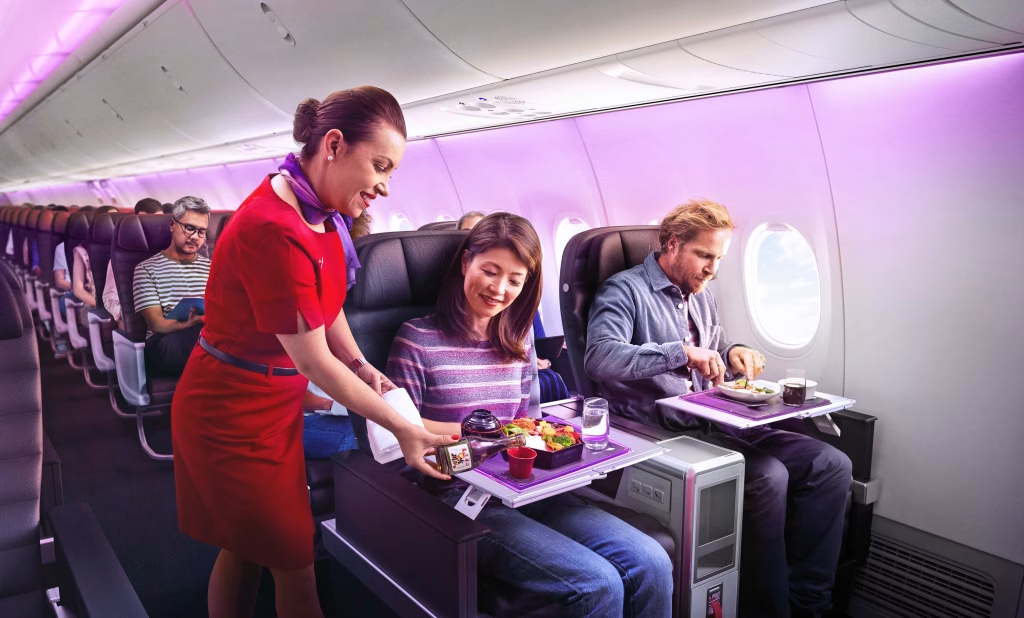

The cheap flatbed era is over as business class airfares soar higher than ever out of Australia.
Business class airfares are sky high out of Australia right now.
There was a time, not so long ago, when a savvy Australian traveler could secure a Business Class throne to London or New York for roughly $4,500 to $5,500 AUD.
It was the era of the “tactical sale”—a period defined by overcapacity, aggressive competition from the “Middle East Big Three” (Emirates, Qatar, Etihad), and a burgeoning secondary market of Asian carriers like China Southern and Cathay Pacific vying for the Australian “Kangaroo Route.”
Fast forward to 2026, and that world has evaporated. Today, the starting price for a Business Class return ticket to the UK or the US from Sydney or Melbourne has anchored itself between $8,000 and $11,000 AUD. This isn’t merely a post-pandemic “hiccup”; it is a fundamental restructuring of the economics of the sky.

The Anatomy of the Price Hike: Why $10,000 is the New $5,000
Several tectonic shifts in the aviation industry have converged to create this “new normal” for Australian travelers.
1. The Capacity Crunch and “Yield Management”
During the pandemic, airlines retired their most expensive assets—most notably the Airbus A380 and the Boeing 747. While some A380s have returned to the skies, the total number of premium seats available out of Australia remains lower than 2019 levels.
Airlines have shifted their philosophy from “filling planes” to “maximizing yield.” By keeping supply slightly below demand, carriers like Qantas, Singapore Airlines, and United have realized they can charge double the previous fare to the 10% of travelers who must fly Business for work or status.
2. The Ultra-Long-Haul Premium
Australia is the birthplace of “Project Sunrise”—the quest for non-stop flights to London and New York. These flights are expensive to operate. Carrying the fuel required for a 20-hour journey is inefficient; essentially, the plane spends the first half of the flight burning fuel just to carry the fuel for the second half.
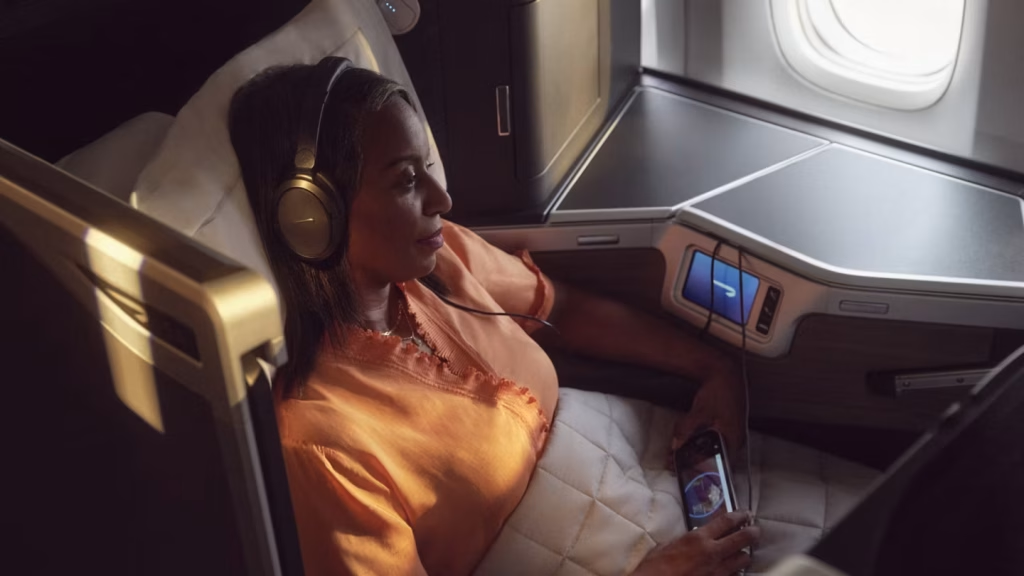
To make these routes profitable, airlines have tilted the cabin configuration heavily toward premium seats. Qantas’s A350-1000s, designed for these routes, feature a massive premium footprint. This “exclusivity” comes with a surcharge that has pulled the entire market’s price floor upward.
The Great Airline Shift: Carrier by Carrier
Qantas: The National Benchmark
Qantas has leaned into its “home ground” advantage. With the introduction of non-stop Perth-to-London and the impending Sydney-to-London routes, they have successfully decoupled their pricing from the rest of the market.
A Business Class fare to London on the “Red Roo” rarely dips below $9,500 AUD now, positioned as a “time-saving” premium that corporate Australia is willing to pay.
The Middle Eastern Powerhouses: Qatar & Emirates
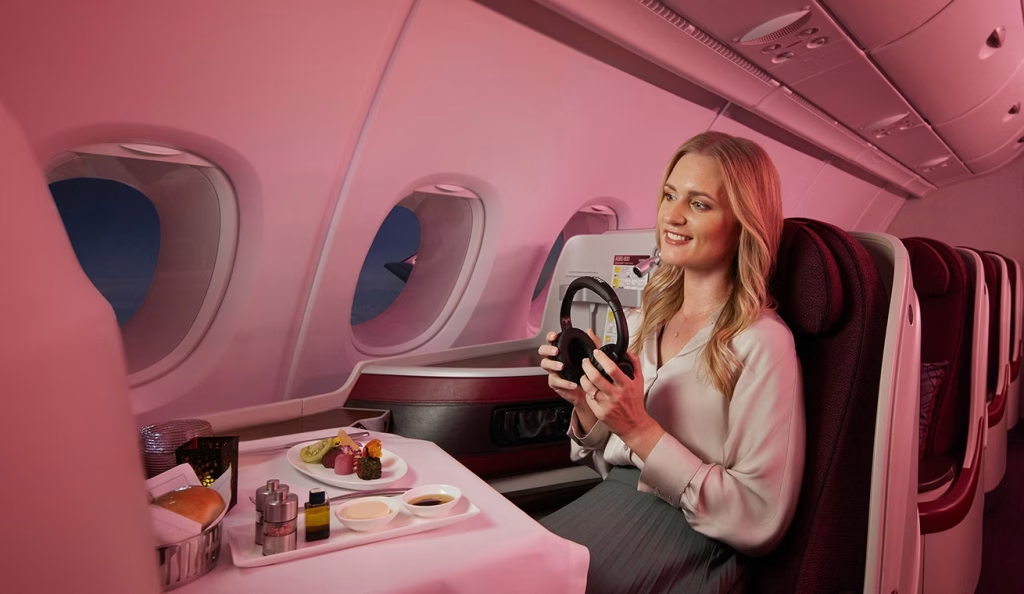
Previously the “price disruptors,” Qatar Airways and Emirates have pivoted. With Qatar’s “QSuite” often voted the best Business Class in the world, they no longer need to compete on price. Their fares to Europe now regularly sit in the $8,500–$10,500 bracket. They have shifted their focus to “seamless connectivity” and lounge luxury rather than the $5k bargain.

The US Carriers: United, Delta, and American
The trans-Pacific route to Los Angeles and New York has seen the most dramatic shift. The entrance of United’s Polarisand Delta One suites has coincided with a massive surge in US-Australia business travel. Pre-Covid, a $5,000 fare to LAX was standard. In 2026, you are hard-pressed to find a seat for under $9,000, as these airlines prioritize their high-spending US-based corporate contracts.
The “Value” Players: Vietnam Airlines & Royal Brunei
For the traveler refusing to pay five figures, a “secondary tier” has emerged. Airlines like Vietnam Airlines and China Airlines (Taiwan) offer Business Class for $5,000–$6,500. However, the “trade-off” involves longer layovers and older seat configurations, proving the old adage: in 2026, you either pay with your wallet or your time.
The Death of First Class and the Rise of “Business Plus”
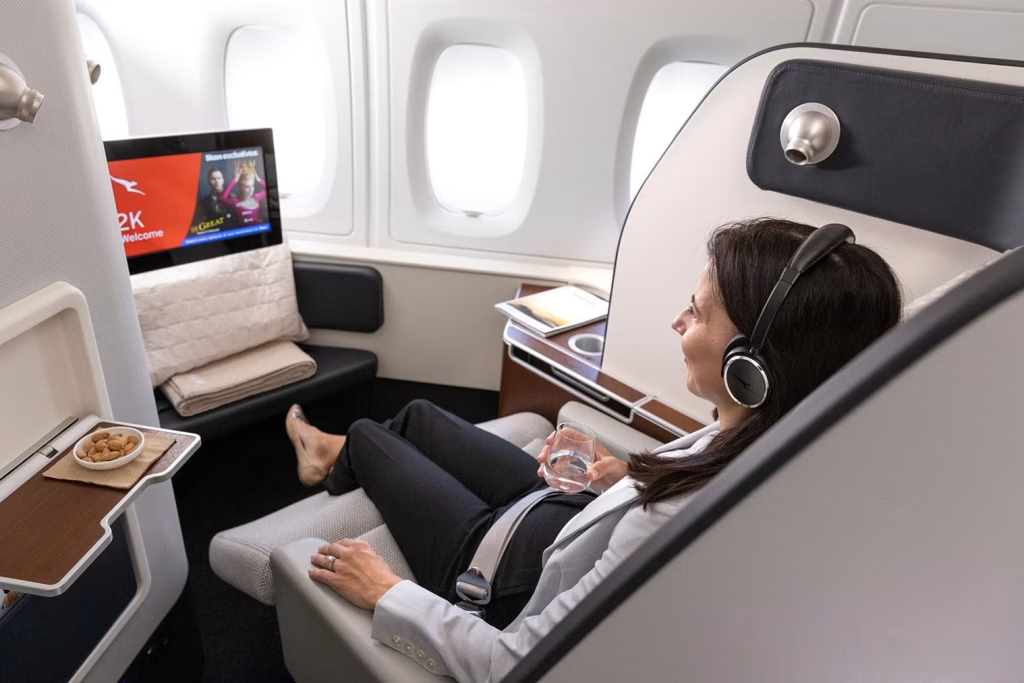
One of the most significant shifts is the cannibalization of First Class. Most airlines have realised that a modern Business Class suite—with sliding doors, lie-flat beds, and 4K screens—is “good enough” for 99% of wealthy travellers.
- The Shift: Airlines like Air New Zealand, Virgin Atlantic, and many Lufthansa routes have removed First Class entirely.
- The Result: The “First Class” experience has been rebranded as “Business Plus” (like the front-row seats in Virgin’s new Upper Class or Qatar’s QSuite).
- The Price Impact: By removing the “buffer” of a $20,000 First Class ticket, the $10,000 Business Class ticket feels, psychologically, like the “middle ground,” even though it is twice the price it used to be.
The “Human Component”: Why We Still Pay
Despite the eye-watering prices, Business Class cabins are fuller than ever. Why?
- The “Revenge Travel” Hangover: The pandemic taught a generation that “life is short.” Retirees and high-income earners are opting for comfort over savings, viewing the extra $5,000 as an investment in their physical health upon arrival.
- Corporate Wellness: Modern HR policies in 2026 are increasingly focused on “Duty of Care.” Asking an executive to fly 24 hours in Economy before a $100M deal is now seen as a liability risk.
- Points Saturation: With millions of Australians sitting on record-breaking piles of Frequent Flyer points, many are using “Points + Pay” to take the sting out of the $10,000 fare, keeping demand artificially high.
ROI: Is the $10,000 Fare Worth It?
From a business perspective, the ROI of a $10,000 Business Class ticket is measured in “Day Zero Productivity.” If a consultant or executive arrives in London at 6:00 AM after a flatbed sleep, they are billable by 10:00 AM. If they arrive after 24 hours in a 31-inch pitch Economy seat, they are effectively “lost” to the business for 48 hours of recovery. At a billing rate of $500/hour, the Business Class seat pays for itself in two days.
The New Ceiling
The Australian international airfare market has hit a new ceiling. While we may see temporary dips to $7,500 during low-season “Early Bird” sales, the days of the $4,000 return Business Class ticket to the Northern Hemisphere are likely gone forever.
The sky has become a tiered society. As airlines continue to refine their “Premium Economy” offerings—now priced at the old Business Class rates of $3,500–$4,500—the front of the plane has been successfully repositioned as an elite, high-yield sanctuary.