

From the first moments of this episode of the podcast Where2FromHere, (seen on YouTube and Spotify), there’s a sense that the story of Four Seasons Hotel Jakarta is inseparable from the story of the man now leading it—Samit Ganguly, a third-generation hotelier whose roots lie thousands of kilometers away, in the bustling, storied streets of Kolkata.
A Hotel Legacy That Began in Kolkata
Samit begins quietly, almost nostalgically, at the Oberoi Grand in Kolkata, the “Grand Dame of Chowringhee,” where his career formally started but his calling had begun long before.
He describes wandering those corridors as a young man, feeling the weight of history pressing gently on his shoulders—grand ballrooms echoing with past celebrations, staff who had served generations of families, and a hospitality culture where details were not tasks, but rituals.
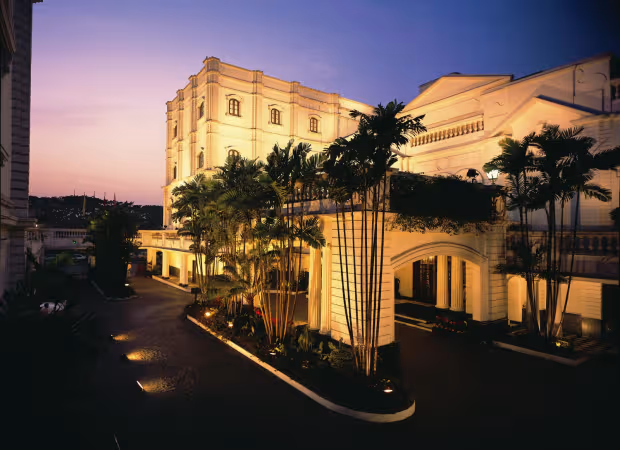
The Oberoi Grand was not just an employer; it was a living, breathing classroom where his grandfather and father had also moved with purpose and pride. In that world, service was not performance—it was a way of being.
The Indian Philosophy of Hospitality
As Renae draws him out, Samit unpacks how his Indian upbringing shaped his leadership philosophy. He speaks of growing up in a culture where guests are treated as gods, where a knock at the door is answered with warm food, a seat, and a sincere question: “How can I make you comfortable?”
That ethos, he explains, has never left him. In the Oberoi world, this idea was institutionalised—training programs, mentors, and senior hoteliers he admired all returned, in some form, to the same principle: hospitality is love in action, delivered with discipline and grace.
The Oberoi Legacy: Luxury in the Details
The Oberoi legacy, as Samit recounts it, is a blend of precision and poetry. He remembers senior managers who knew the preferences of regular guests down to how they liked their tea stirred. He recalls the way the property held space for both the grandeur of weddings and the quiet dignity of business travelers who simply needed rest. The legacy wasn’t only about chandeliers and silver cloches; it lived in the small nods, the anticipatory gestures, the handwritten notes that made people feel seen.
For insider places to eat, stay and drink in Jakarta, click here.

These early lessons forged his belief that luxury is not loud—it is deeply, sometimes almost invisibly, attentive.
From Oberoi to Four Seasons
When the conversation shifts to his move into Four Seasons, Samit speaks of a new chapter built on those foundations. He describes Four Seasons’ leadership training, developed in partnership with Harvard, as a transformative bridge from instinct to structured strategy.
There, his intuitive sense of hospitality met frameworks on organizational culture, emotional intelligence, and leading through complexity. It was, he says, an education not just in management, but in how to scale empathy—how to ensure that a philosophy of care reaches from the general manager’s office to the night steward quietly polishing glasses at 2 a.m.

Inside Four Seasons Hotel Jakarta
With this training in hand, Samit stepped into his role at Four Seasons Hotel Jakarta—a 125 all-suite property he calls “a jewel box of timeless architecture.” He paints a vivid picture: high ceilings, Jakarta’s light filtered through generous windows, interiors that blend European classicism with Indonesian artistry. Suites unfold like curated residences, with distinct zones for rest, work, and contemplation. (For more on Jakarta’s best places to eat, drink and stay, click here)
Marble bathrooms catch the morning sun; bespoke artworks reference local culture without falling into cliché. Every corridor, every lounge, feels intentionally scaled: intimate enough to recognize faces, grand enough to remind you that you are in one of the city’s most refined addresses.
A New Approach to Wellness
Renae leans into the topic of wellness, and Samit’s eyes—if one could see them through audio—seem to sharpen with passion. At Four Seasons Jakarta, wellness is not an add-on at the end of a hallway; it’s a philosophy threaded through the guest journey.
He explains that they are moving away from a one-size-fits-all spa menu toward specialized programs tailored to each traveler’s needs. Before treatments, there are thoughtful conversations about sleep patterns, stress levels, travel fatigue. Bodywork, nutrition recommendations, and mindfulness moments are then woven into a personalized arc for each stay, whether it’s one night or a week.

It is here that Samit introduces “Aditi Deva Bhava,” an initiative inspired by the Sanskrit phrase meaning “Guest is God.” He describes it as both a cultural bridge and a guiding principle for his Jakarta team. The idea is not to impose Indian customs on Indonesian soil, but to use that deeply rooted reverence for guests as a lens through which local hospitality can shine even brighter.
Staff are encouraged to see each interaction as an offering—of time, of attention, of presence. This, Samit believes, is where wellness truly begins: when guests feel safe, recognized, and gently cared for in a way that honors both their individuality and the culture of the host country.
Renae then invites him to comment on the global influence of Indian hotel managers. Samit answers with a mix of humility and pride. He speaks of a generation of Indian hoteliers now running properties across continents, often grounded in the rigorous training and service standards of Indian luxury brands. He notes that this background, combined with India’s own cultural complexity, equips them to navigate multinational teams and diverse guest expectations with ease. It is not about exporting a single style of hospitality, he says, but about bringing an instinct for warmth, adaptability, and respect for tradition into every new context.
The contrast between working cultures in India and Indonesia fascinates them both. Samit describes India’s high-intensity dynamism—its relentless pace, density, and layered hierarchies—alongside Indonesia’s gentler rhythm and deep sense of community. In Jakarta, he has found a workforce eager to learn, collaborative by nature, and grounded in kindness.
His leadership challenge and joy is blending these worlds: retaining the rigor and discipline he values, while honoring Indonesia’s softer edges and communal warmth. The result, he hopes, is a work culture where excellence never feels harsh, and expectations are delivered with humanity.

When the conversation turns to travel, the general manager becomes simply Samit, the curious global citizen. He talks about London with a sense of intellectual delight: a city of layered history and modern pulse, where a single walk can take you from royal palaces to edgy galleries.
Prague, to him, is a fairytale rendered in stone and spires, a place where time seems to slow as you cross the Charles Bridge. Budapest, with the Danube cutting through its center, feels like a dialogue between eras—thermal baths and coffeehouses standing alongside contemporary design and cuisine. These cities inspire him not only as destinations, but as living examples of how culture, architecture, and hospitality can converse across centuries.
As the episode draws toward its close, Renae asks the signature question: “Where to from here, Samit?” His answer is less about promotions or pipelines and more about purpose. He talks about legacy not as a plaque on a wall, but as the quiet, cumulative impact of daily decisions.
He wants his team to remember that they were empowered, trusted, and developed. He hopes guests will look back on their time at Four Seasons Jakarta and recall not just beautiful suites or flawless meals, but a feeling of being genuinely welcomed, rested, and renewed.
Ultimately, Samit frames his own success as inseparable from the successes of those around him. The housekeepers who notice a child’s forgotten toy and place it on a pillow. The doorman who learns a guest’s routine and has an umbrella ready before rain even begins. The spa therapist who understands that, for one exhausted traveler, silence is more healing than conversation. These, he says, are the moments that build a legacy—brick by human brick.
In this richly layered episode of Where2FromHere, Renae doesn’t just introduce a new general manager; she reveals how tradition, culture, and modern leadership converge in one man’s life and in one very special hotel. Through Samit’s stories, Four Seasons Hotel Jakarta emerges as more than a luxury address. It becomes a living canvas where Indian heritage, Indonesian warmth, and global standards of excellence come together to craft the kind of guest journeys that linger long after check-out—and perhaps, in their own quiet way, define what the future of luxury hospitality can be.
Click below to watch and/or listen.


