

The rise of regenerative hotels and the shift reshaping where—and how—the wealthy stay
Luxury travel has always been about access—access to extraordinary places, rare experiences and a level of ease that feels increasingly elusive in daily life. In 2026, however, that definition is shifting in a way that is both subtle and profound. The most compelling hotels in the world are no longer simply opening doors to exceptional destinations. They are restoring them.
What is unfolding across the upper tier of global hospitality is not a marketing pivot. It is a structural reset. Sustainability, once positioned as a responsible add-on, has evolved into something far more ambitious: regeneration. And for Australians who travel far, spend well and expect depth in return, this is fast becoming the new benchmark.
The difference between sustainability and regeneration is not semantic. Sustainability aims to reduce harm. Regeneration goes further, actively improving ecosystems, rebuilding biodiversity and creating long-term environmental value. Increasingly, this is where the most intelligent luxury brands are focusing their investment.
Few have embedded this philosophy as convincingly as Soneva. At its Maldives and Thailand properties, sustainability is not a program—it is the operating model. Solar energy powers significant parts of the resorts, waste is meticulously sorted and repurposed, and guests are often drawn into the process, whether through organic gardens, marine conservation projects or on-site recycling centres.

There is even a carbon levy built into the guest experience, funding global environmental initiatives. It is immersive, intelligent and, importantly, it does not feel like compromise.
Similarly, Six Senses has emerged as one of the most influential players redefining modern luxury. At its newest urban outposts, including London, sustainability is no longer reserved for remote island resorts. It is integrated into dense, high-demand city environments, where energy systems, water usage, wellness programming and food sourcing are all designed with precision. The brand’s long-standing commitment to eliminating plastic, sourcing locally and investing in biodiversity is now being applied to some of the world’s most complex urban settings.
For a well-travelled Australian audience, this matters. The expectation is no longer just that a hotel looks beautiful or delivers exceptional service. It must also demonstrate intelligence—how it operates, what it consumes and what it gives back.
Nowhere is this more evident than in the growing movement towards rewilding. Across Europe, the Americas and parts of Australasia, luxury hotel groups are investing in large-scale ecological restoration, often spanning thousands of hectares. These projects go beyond conservation. They aim to return land to its natural state.
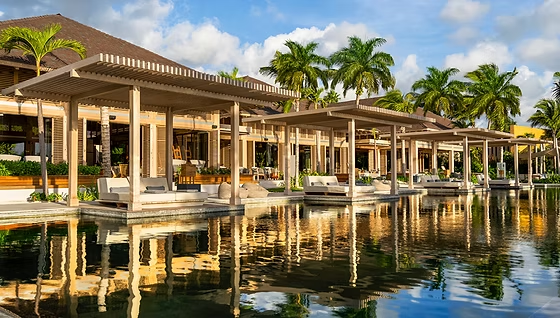
In Hawaii, Sensei Lānaʻi, A Four Seasons Resort sits within a broader vision of land stewardship, where reforestation and native species restoration are central to the guest experience. In Chilean Patagonia, Explora Patagonia National Park operates within a landscape that has undergone extensive restoration, transforming former farmland back into protected wilderness.
Closer to home, Southern Ocean Lodge offers one of the most compelling Australian examples. Rebuilt after devastating bushfires, the property has been designed with a clear focus on ecological recovery, from native revegetation to sensitive architectural integration with the landscape. It is a powerful reminder that luxury, when done properly, can play a role in healing rather than simply occupying a place.
Technology, meanwhile, is quietly reshaping the operational backbone of these properties. Artificial intelligence is becoming one of the most effective tools in reducing environmental impact, particularly in food systems. Food waste has long been one of the industry’s most significant challenges, both environmentally and financially.
At leading properties, AI-driven platforms now track exactly what is being discarded in kitchens, identifying patterns and inefficiencies with remarkable accuracy. Chefs are able to adjust menus, portion sizes and procurement strategies in real time. The outcome is not austerity, but refinement. Less waste, more precision, and often a more thoughtful dining experience.

Brands such as Banyan Group are taking a similarly holistic approach, combining technological innovation with deep community engagement. Their resorts are designed to operate in harmony with local environments, while also investing directly in surrounding communities through employment, education and local sourcing. This is not peripheral. It is central to the brand’s identity and increasingly, to its commercial success.
Dining, in particular, has become a focal point for this evolution. The traditional markers of luxury—abundance, global sourcing, excess—are being replaced by something more nuanced. Provenance, seasonality and locality now define the most interesting hotel kitchens.
At properties across the Six Senses portfolio, ingredients are often sourced within a tight radius or grown on site. Menus shift with the seasons, and plant-forward dishes are treated with the same level of creativity as any fine dining offering. This is not about restriction. It is about precision and depth.
In Africa, Singita has long demonstrated how high-end tourism can directly support conservation. Its lodges operate within protected reserves, with revenue contributing to wildlife protection and land management. Guests are not just observing nature; they are, in a sense, funding its survival.

The way Australians are travelling is also evolving, and this is shaping the industry in return. There is a clear move towards slower, more intentional journeys. Rather than moving quickly between destinations, travellers are choosing to stay longer, engage more deeply and prioritise quality over quantity.
This shift is particularly relevant for a long-haul market. When travel requires time and investment, the expectation is that the experience delivers on every level. Hotels are responding with extended-stay offerings, integrated wellness programs and experiences designed to unfold over days rather than hours.
Even ultra-luxury brands such as Aman Resorts are leaning into this model, developing properties in remote, low-impact locations where privacy, nature and sustainability converge. These are not places to pass through. They are destinations in themselves.
What ties all of these developments together is a shift in mindset. Luxury is no longer defined by excess. It is defined by intention. It is about how a place is built, how it operates and what it contributes to its environment and community.

For Australian travellers—globally aware, environmentally conscious and increasingly selective—this evolution feels both necessary and overdue. The expectation is not just that a hotel delivers an exceptional stay, but that it reflects a broader understanding of the world it occupies.
The most forward-thinking properties are already there. They are producing their own energy, reducing waste with precision, restoring ecosystems and embedding themselves within local communities in meaningful ways.
This is not a passing trend. It is the future of the industry. And selecting a holiday is no longer simply where you want to go. It is what your stay will leave behind.


