

Giovanni Pilu on Michelin Australia, celebrity chefs and the future of Italian dining
In a revealing Where2FromHere interview with Renae Leith-Manos, acclaimed Sardinian chef Giovanni Pilu talks Michelin’s controversial Australian arrival, the problem with celebrity-chef culture, the pressure facing restaurants, authentic Italian food, social media and why no great kitchen is ever about one person.
There are chefs who build careers around being recognised, and there are chefs who build restaurants people keep returning to. Giovanni Pilu belongs firmly in the second camp.
For more than three decades, the Sardinian-born chef and restaurateur has helped shape the way Australians understand regional Italian food. His celebrated Pilu at Freshwater, opened with his wife and business partner Marilyn Annecchini in 2004, has become one of Sydney’s most enduring destination restaurants, its position overlooking Freshwater Beach almost as distinctive as the food itself. Pilu’s official restaurant history records a remarkable run of recognition from the Sydney Morning Herald Good Food Guide, while the restaurant remains deeply focused on Sardinian regionality, local produce and hospitality.
But in a fascinating new episode of Where2FromHere with Renae Leith-Manos, Pilu is less interested in looking backwards than talking about what is happening to restaurants right now. And he has plenty to say.
From Michelin finally coming to Australia, to celebrity chefs, Instagram, the economic reality of running restaurants, the distortion of authentic Italian food and the rise of elevated casual dining, this is a conversation about an industry undergoing profound change.

Michelin Is Finally Coming to Australia. But Does Australia Need Michelin?
One of the interview’s most compelling discussions centres on the Michelin Guide’s long-awaited arrival in Australia.
Until now, Australia has never had restaurants included in the Michelin restaurant guide. That changes with the MICHELIN Guide South Australia 2027, making South Australia the first Australian destination to join Michelin’s global restaurant network. Inspectors are already assessing restaurants in Adelaide and regional South Australia, with the inaugural selection scheduled to be announced in October 2026.
How Michelin got here, however, makes the conversation far more interesting. The South Australian Government has entered a commercial partnership with Michelin through the South Australian Tourism Commission. The official cost has not been disclosed and remains commercial-in-confidence. ABC reported that South Australia paid an undisclosed amount to secure the guide, while one industry report has put the investment at approximately A$6.3 million over three years.
That inevitably raises a provocative question. If Michelin recognition is supposedly the ultimate independent validation of a dining destination, should a government have to pay millions of dollars for Michelin to come?
Michelin insists that while tourism organisations may fund the establishment and promotion of the guide in a destination, inspectors operate independently and restaurants cannot buy inclusion or awards. Its inspectors assess restaurants according to universal criteria including ingredient quality, technical skill, flavour harmony, personality and consistency.
But Pilu’s discussion with Leith-Manos goes further. Why South Australia first? Why not Sydney, with its extraordinary concentration of restaurants, international chefs and produce? Would a Michelin presence make Australian restaurants more relevant internationally? And, perhaps most importantly, after decades of producing world-class food without it, does Australia actually need an overseas guide to tell us that our restaurants are good? It is precisely the kind of debate Michelin’s arrival was always going to create.
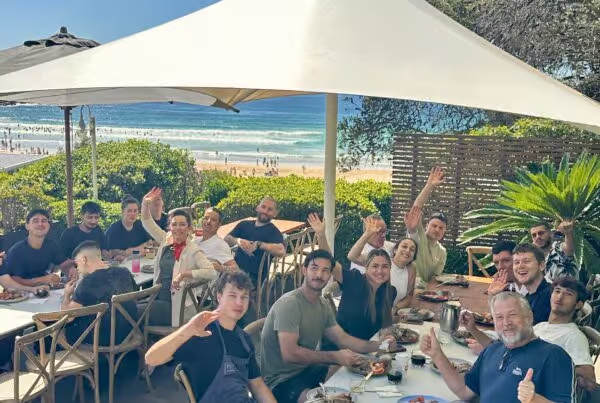
Giovanni Pilu’s Problem With the Celebrity Chef
Pilu is equally forthright when the conversation turns to the rise of the celebrity chef. For him, the mythology surrounding one superstar standing at the centre of a restaurant misses something fundamental.
Restaurants are teams.
A great restaurant depends on the chefs beside you, the people washing dishes, the sommeliers, waiters, managers, suppliers and the people welcoming guests through the door.
Pilu’s own restaurant reflects that philosophy. Pilu at Freshwater describes the experience as one created jointly by Giovanni, Marilyn and a longstanding front-of-house, sommelier and kitchen team.
It is a particularly refreshing perspective in an era when restaurants can increasingly be marketed around one highly visible individual. Pilu questions whether celebrity-chef culture is ultimately good for hospitality at all.
The idea that one person is responsible for a restaurant’s success can diminish the contribution of the dozens of people required to create an exceptional service every day. It can also place enormous pressure on younger chefs to build a profile at the same time they are supposed to be learning their craft.
Pilu has previously resisted the celebrity-chef label himself. Speaking to SBS about television appearances, he made it clear that his priorities remained the kitchen, restaurant and staff rather than becoming a television personality.
His position in the Where2FromHere conversation is clear: the kitchen should never become about the ego of one individual.

Why Australians Still Get Italian Food Wrong
For Pilu, authenticity begins with understanding a deceptively simple fact: There is no single Italian cuisine. Italy is intensely regional. Sardinia does not cook like Sicily. Naples does not eat like Tuscany. Venice, Genoa and Cagliari each developed culinary identities shaped by geography, climate, agriculture, history and what people could access locally. Pilu knows this instinctively.
He grew up in Sardinia and arrived in Sydney in 1992 after beginning his hospitality career on the island. His regional approach would eventually help introduce Sydney diners to ingredients and dishes that were then largely unfamiliar in Australia, particularly Sardinian staples such as bottarga and fregola.
During the podcast, he and Leith-Manos discuss what Australians continue to misunderstand about Italian cuisine and why simply putting the word “Italian” above a restaurant door tells you very little. There are also dishes he believes should simply be respected.
Carbonara is one of them.
In an age when chefs are encouraged to reinvent everything, Pilu argues that understanding why a classic dish works may be far more important than desperately trying to make it different. Sometimes innovation is appropriate. Sometimes the smartest thing a chef can do is leave a great dish alone.

Has Instagram Made Restaurants Better—or Worse?
Then there is social media. Instagram and TikTok have transformed how restaurants are discovered, judged and sometimes even designed.
Food now has to compete for attention on a six-inch screen before many guests ever taste it. That has unquestionably produced positives. Restaurants are thinking more carefully about presentation, interiors, lighting and visual identity. But Pilu and Renae explore the other side.
What happens when food starts being designed for the camera rather than the diner?
What happens when a guest spends the opening minutes of every course photographing, filming and repositioning the plate while the food gets colder?
And has the pressure to produce viral dishes made restaurants confuse visual novelty with culinary quality?
It is an increasingly relevant question for luxury hospitality, where the experience itself is now routinely interrupted in order to document the experience.

The Brutal Economics Behind Beautiful Restaurants
The glamour surrounding restaurant culture also hides an uncomfortable commercial reality.
Restaurants can be full and still struggle financially. Pilu discusses some of the pressures now confronting Australian hospitality: wages, produce prices, staffing, operating expenses and changing consumer behaviour. It makes the longevity of Pilu at Freshwater all the more remarkable.
Opening in 2004, the restaurant has survived more than two decades of changing tastes, financial cycles, rising costs and enormous disruption within hospitality. Remaining relevant for 20-plus years requires far more than having a famous chef.
It requires discipline, loyal customers, consistent food, staff who want to stay and the ability to evolve without abandoning the reason people loved the restaurant in the first place.
Flaminia: Giovanni Pilu’s New Sydney Harbour Chapter
That evolution is now visible at Flaminia, Giovanni and Marilyn’s new restaurant at Circular Quay.
Located within Pullman Quay Grand Sydney Harbour, Flaminia takes its inspiration from Italy’s port cities, with influences from Cagliari, Naples, Venice, Genoa and Palermo. The restaurant opened in December 2025 and looks across one of the world’s most recognisable harbours. It also represents a different expression of Pilu’s cooking.
Rather than reproducing the experience of Pilu at Freshwater, Flaminia embraces what Giovanni describes in the podcast as elevated casual dining: serious ingredients, technique and hospitality without unnecessary formality.Even the name has an extraordinary personal connection.
Flaminia was the ship that brought Marilyn Annecchini’s family from Italy to Australia in 1959, linking the restaurant’s Italian coastal identity directly to a family migration story and, fittingly, to Sydney Harbour itself. It is difficult to imagine a more personal name for the couple’s next chapter.
Where2FromHere, Giovanni Pilu?
Perhaps the most revealing theme running through the entire conversation is that Pilu has little interest in chasing whatever hospitality happens to be celebrating this year.
Not Michelin stars. Not celebrity. Not Instagram fame. Not reinvention simply for reinvention’s sake. His career has instead been built around regional food, consistency, hospitality and people. And as Michelin prepares to judge Australian restaurants for the first time, Pilu offers a useful reminder of something no rating system can completely quantify:
A great restaurant is not one chef. It is an ecosystem of people creating something together, service after service, year after year.
That may explain why, more than 20 years after opening the doors at Freshwater, Giovanni Pilu remains one of the most relevant voices in Australian hospitality.
Watch: Giovanni Pilu on Where2FromHere with Renae Leith-Manos
In this episode, Giovanni Pilu and Renae Leith-Manos discuss the rise of elevated casual dining, the financial challenges facing Australian restaurants, Giovanni’s early years in Sardinia and Australia, authentic regional Italian cooking, the dishes Australians routinely get wrong, Michelin’s arrival in South Australia, social media and restaurant culture, celebrity chefs, the pressure on modern chefs and what comes next.


